First Drive: Toyota Hilux BEV
- 11 June 2026
- 0
The first battery electric Hilux has a specific audience in mind. By Simon Harris. What is it? Electric AWD pickup truck How much? From £57,845 Gross payload: 715kg

The first battery electric Hilux has a specific audience in mind. By Simon Harris. What is it? Electric AWD pickup truck How much? From £57,845 Gross payload: 715kg
The first battery electric Hilux has a specific audience in mind. By Simon Harris.
What is it? Electric AWD pickup truck How much? From £57,845 Gross payload: 715kg Efficiency: 3mpkWh Drive: Front/rear electric motors, 194hp
When Toyota’s engineers set out to develop an electric Hilux, they gave themselves a clear brief: not a BEV that looked like a Hilux, but a Hilux that was a BEV. It is a distinction that matters, and one that shapes everything about this vehicle.
The ninth-generation Hilux range makes its electric debut with a powertrain built around a 59.2kWh water-cooled lithium-ion battery mounted within the frame, driving permanent four-wheel drive through front and rear eAxles producing a combined 196hp and 473Nm of torque.
That permanent AWD is actually an advantage over the diesel variant, which requires the driver to engage four-wheel drive manually. What the BEV loses is the ability to lock the differentials, a limitation worth noting for those whose working lives take them into genuinely extreme terrain.
For the core audience Toyota has in mind, however, that is unlikely to be a dealbreaker. This is not primarily a vehicle for remote expedition work. It is aimed at airside duties, highway maintenance operations and urban fleets where low emission zone restrictions are making diesel increasingly difficult to justify. For those applications, the Hilux BEV makes a compelling case.
On the road, the experience is immediately striking. The Hilux feels exactly as solid and purposeful as any diesel variant, the body-on-frame construction, the commanding driving position, the sense that this vehicle will absorb whatever is asked of it, but the soundtrack has changed entirely. Wind and tyre noise aside, it is close to silent, the only intrusions being the now-mandatory audible alerts for lane keeping assist and speed limit warnings. For drivers spending long shifts in the vehicle, that quiet is not a small thing.
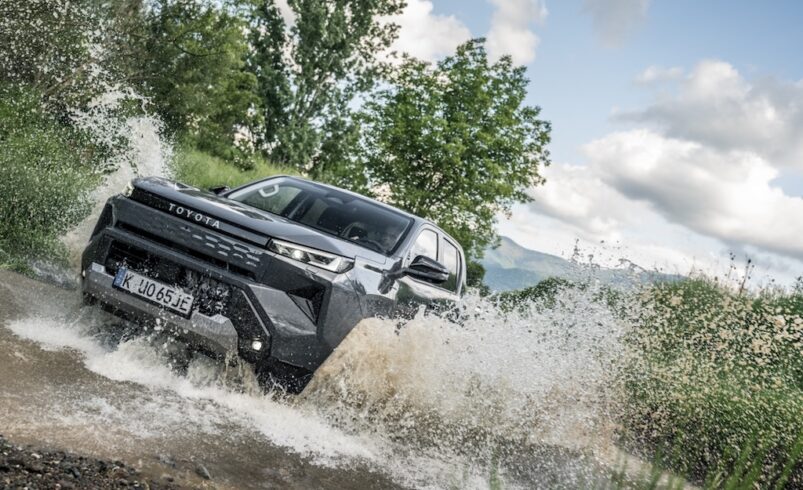
Our test route pushed the BEV well beyond urban comfort, taking in a steep hillside track and deep, rutted terrain that would have tested any vehicle on standard road tyres. The Multi-Terrain Select system provides five modes covering rock, sand, mud, dirt and mogul. The last of these, which is a first for a Toyota BEV, proved its worth here, adjusting torque delivery and braking with precision that gave genuine confidence on shifting surfaces. The vehicle felt thoroughly at home, the electric motors’ instant torque responding cleanly to the demands of the terrain.
The lower ground clearance relative to the diesel did make itself known occasionally in the deepest ruts, brushing the surface lightly. It is a real, if minor, compromise. The 700mm wading depth and 29-degree approach angle are matched to the diesel, but those seeking the absolute maximum off-road capability will want to factor the reduced break-over angle into their thinking.
Range is the other consideration. Toyota quotes approximately 160 miles on the WLTP combined cycle from the 59.2kWh battery, with DC fast charging to 80% available in around 30 minutes. For depot-based operations with predictable daily mileages, that is workable. For anyone expecting to cover the same ground as a diesel Hilux on a single charge, it is not.
Prices start at £57,845 for the Icon grade and £60,695 for the Invincible, though both qualify for the Government’s £5,000 plug-in van grant, bringing the entry point to £52,845. Customer deliveries begin in mid-June.
Key fleet model: Icon
For: Quiet cabin; rugged; 10-year warranty potential
Against: Range limits applications
Summary: Tough and capable with full Hilux credentials
Verdict:
The Hilux BEV is a genuine working vehicle that happens to be electric, rather than an electric vehicle attempting to be a Hilux. For the right operator, it makes a strong and increasingly relevant case.