LCV Essentials: Make light work of heavy lifts
- 15 October 2025
- 0
What equipment can be fitted to LCVs to avoid manual handling mishaps? Matt MacConnell investigates. Lift with your knees, not your back! That’s easier said than done, especially

What equipment can be fitted to LCVs to avoid manual handling mishaps? Matt MacConnell investigates. Lift with your knees, not your back! That’s easier said than done, especially
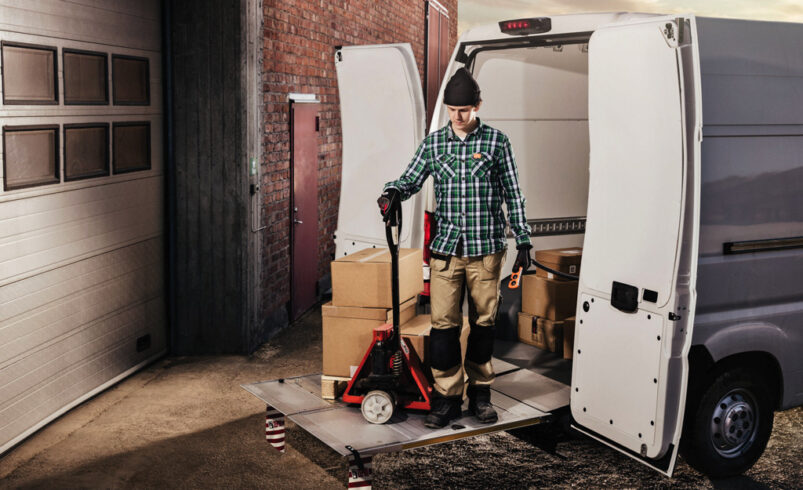
What equipment can be fitted to LCVs to avoid manual handling mishaps? Matt MacConnell investigates.
Lift with your knees, not your back! That’s easier said than done, especially after you’ve already loaded 50-plus parcels into the back of a Renault Trafic – and it only takes a split second for an accident to occur.
According to Unison.org, one in three accidents at work is caused by manual handling errors, with over 300,000 resulting in back and neck or spine injuries. Information from the Reporting of Injuries, Diseases and Dangerous Occurrences Regulations (RIDDOR) shows that in 2023-2024, injuries while handling, lifting or carrying were the second commonest among non-fatal injuries, accounting for 17% of total non-fatal injuries.
By law, employers must reduce the risk of injury from manual handling to the ‘lowest level reasonably practicable’ – and risk assessments must be carried out before any manual handling operation takes place. Training and information must also be provided regarding load weight and the load’s heaviest side if its centre of gravity is not positioned centrally.
The employee must also abide by HSE regulations and adhere to their company’s rules, while using common sense when lifting, manoeuvring and transporting objects. If a company fails to follow regulations and an employee has an accident while loading a van, the employee could sue the company. However, while expensive, equipping a fleet with loading equipment could massively reduce the risk of manual handling injury.
The most popular systems are hydraulic cranes and tail-lifts. Many Luton van producers offer optional tail-lift systems, while others include these as standard. Tail-lifts typically handle weights up to 500kg and are a perfect solution for furniture delivery companies or transporting heavy equipment. They fold neatly against the van’s rear doors, maximising its load area.
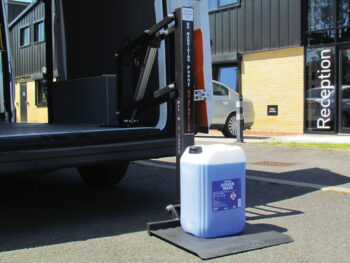
Smaller lift systems also exist, such as the LoadLift platform offered by Penny Engineering, which lifts up to 250kg and folds away inside the van when not in use. This system is ideal for lifting parcel cages and is used by Royal Mail. This modular system can also be adapted to lift oil drums and tyres.
While large tail-lift systems remain largely unchanged (why fix it when it works?), crane systems have been adapted to accommodate various job types while saving space. Smaller crane systems, which are fitted inside the van against a wall behind the rear doors or side doors, can typically lift between 250kg and 500kg, making them ideal for transporting equipment such as air compressors, engine blocks and whacker plates. These usually have a 1.5m boom, are operated by the van’s battery and tuck away to save space.
Utilising a van’s load space can be critical, especially if the vehicle is equipped with additional racking or machinery; therefore, a roof-mounted crane might be a better option for some fleets. These cranes can lift 500kg, depending on the make and model, have a boom length of around 227cm and weigh between 150 and 190kg. Luckily, most cranes, excluding the roof-mounted cranes, can be relocated anywhere in the van’s loading bay, meaning they can be used for loading via the van’s side door or rear doors.

Of course, cranes have a maximum boom reach, meaning heavier items need to be dropped in the van’s vicinity for the crane to be able to load them. Smaller hand fork trucks, known as mini lifters and stackers, can be used in this instance and typically lift anywhere between 100 and 250kg. These are usually operated via hand and foot pumps, meaning no charging is required; they cost much less than a larger forklift or pallet truck and can also be stowed in the van’s loading area.
Likewise, mobile scissor lift tables are ideal for shifting bulkier items. They can also carry up to 500kg but require a bit more space when being stored. If your fleet specialises in glass, marble or steel, a suction lifter could suffice. These are often made from extra-strength aluminium and form a super-strong vacuum to facilitate safe, secure lifting of heavy, smooth-surfaced items, and most lift up to 75kg.
Not every fleet can throw money at lifts and cranes and in some cases, depending on the fleet, these might be overkill. Instead, manual lifting slings could be a handy tool to have when lifting items up to 50 to 100kg. These slings are often made from durable fabric and are designed to wrap around circular items, such as cast-iron water gate valves – and minimise bending and lifting efforts. They take up little space and can be stowed in a racking system when finished.
Similarly, there are lifting and moving straps, which again can be easily stowed away when not in use. These straps require two people for use, but they can lift heavier items, usually up to 360kg, such as fridges and washing machines. The harness-like straps wrap around each person and use leverage from your legs and shoulders, leaving your hands free to stabilise the equipment being moved.
Another slightly more expensive option is roller crowbar and skate sets, such as those offered by industrial supplier Hall Fast. These skates typically weigh between 31 and 131kg, depending on model, and can be used to shift between two and 36 tonnes. Hall Fast also offers chain hoists, electric tugs and sack trucks.
Chain hoists have been used in industrial lifting for years. They come in all shapes and sizes and can lift between 50kg and 500kg, the latter being a more expensive electrically powered option. Heavier chain hoists are usually secured to a solid point, such as a beam, and are more suited to construction sites, while many lighter applications can be secured to a fixed point within a van.
Electric tugs, while expensive, can haul between one and 1.5 tonnes over smaller distances and are easy to store. Finally, there are sack trucks. Sack trucks, as the name suggests, were originally designed to haul material sacks, but these have since evolved and can now be fitted instead with pallet forks. Sack trucks are often equipped with electric motors to ease material transportation and can be stored in a van thanks to their compact dimensions.
As more fleets embrace electrification, further grey area topics arise, such as increased electrical load. Equipping an electric van with tail-lifts and cranes will, of course, have a detrimental effect on the vehicle’s range, caused not only by additional electrical load but also by weight. Most of the aforementioned equipment can weigh up to 190kg and electric vans simply aren’t as advanced in battery range as electric cars.
Therefore, if your fleet covers large mileage, it’s worth investing in a van with a larger range. This will give the driver a bit of a buffer during the winter months when the van’s range has already decreased due to temperature change.
For fleets shifting to electric, some groups, such as Stellantis (Vauxhall, Fiat, Citroën and Peugeot), offer in-house outfitting services, allowing the fleet manager to specify what each van. Stellantis will also work with other outfitting companies at customer request, so that the van leaves the factory with the required equipment, saving time and money.