Steering change: Inside Paul Middleton’s fleet transformation at SCCI Alphatrack
8 July 2026
0
Simon Harris
When Paul Middleton arrived at SCCI Alphatrack as fleet manager, he inherited a fleet that had grown without a dedicated hand on the tiller. Insurance costs were climbing,
When Paul Middleton arrived at SCCI Alphatrack as fleet manager, he inherited a fleet that had grown without a dedicated hand on the tiller. Insurance costs were climbing, driver behaviour was an afterthought and there was plenty of work to do. Eight years on, he has cut accidents, transformed driver culture, saved the business more than £200k on its insurance in a single year, and taken home the Financial Superstar Award at the Great British Fleet Awards in April. He spoke to Simon Harris about how he did it.
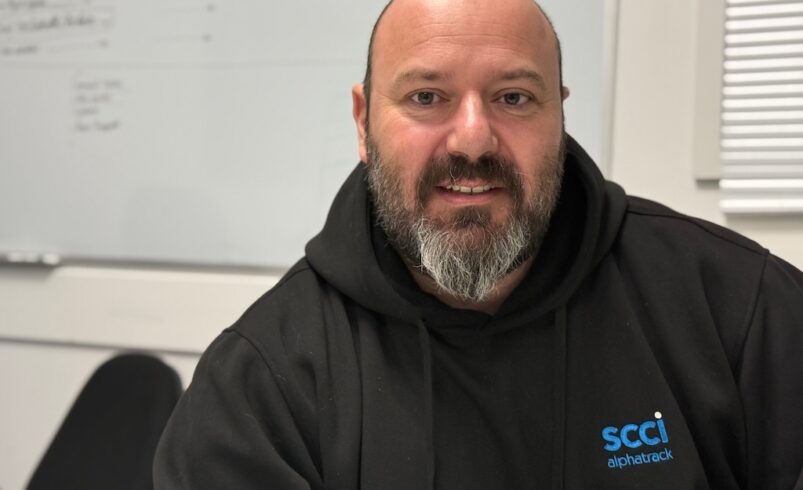
Paul Middleton took home the Financial Superstar Award at the 2026 Great British Fleet Awards
Paul Middleton is not shy about where he found the fleet when he joined SCCI Alphatrack. The vehicles sat within the health and safety department, driving was considered secondary to everything else, and there was no induction process for drivers at all. For someone who had spent his career running minicab fleets, chauffeur fleets and rental operations – where the vehicles are the business – it was a significant adjustment.
“Where I had worked before, the vehicles actually generated income, so were much more of a priority,” he says. “Here, hiring the right engineer is important, but there was less of a focus on driver behaviour.”
The consequences were showing up in the insurance figures. Accidents were frequent, costs were rising, and Middleton could see the trajectory. He made the case to the business in the starkest terms he could find.
“I had to try to convince everyone that as our insurance costs were increasing, we might end up in a situation where we could no longer get insurance and need to self-insure,” he says. “Once I put that point across, it settled in. We had experienced a difficult year of accidents and insurance costs. And I think that’s when they realised how serious it could be.”
Getting driver buy-in, he says, came down to a simple philosophy. “I’m a true believer in that you catch more flies with honey than you do with dung. If you put incentives in to reward the drivers they tend to respond positively and understand what you’re trying to achieve, rather than just punishing the ones that don’t perform well.”
Changing the broker relationship
Driver behaviour was only part of the problem. The insurance and broker arrangements were also falling short, and Middleton was carrying the consequences largely on his own. “I’ve got 250-plus vehicles to look after on my own. I cannot do all of that. I can’t do everything. And they’re not supporting me,” he recalls telling his bosses.
After eight years at the helm, Middleton has cut accidents and insurance cost and transformed driver culture
The breaking point came when a vehicle went through a house and the broker’s response fell well short of what the situation demanded. The managing director got involved and, as Middleton puts it, was “fuming”. New brokers were brought in. This time, Middleton sat down with them and set the terms himself.
“I’ve been a fleet manager for maybe 20 years. I’ve done this at every company that I’ve been with. I’ve never failed to save the money on insurance – in many places, halve the cost,” he told them. “This is the only company I’ve ever been to where the insurance has actually gone up.”
The new broker’s response was simple: tell us what you want and we’ll do it that way. Middleton then brought the insurer in directly, walked them through his concerns, and agreed a new way of working. Accidents would be reported immediately via a driver app he had developed with FleetCheck. Footage and incident details would reach the insurer within an hour. Local body shops were brought in that recycled parts where possible rather than automatically ordering new ones. Spare fleet vehicles were used in place of hire cars wherever feasible.
“It’s about trying to make the whole process run as quickly, as smoothly and as simple as possible,” he says. “And doing it as cheaply as we can.”
The £200k saving
The results came faster than Middleton had expected. Training videos were introduced to communicate risk to drivers. A monthly league table of safety scores was circulated to all engineers and their managers, showing not just overall scores but top speeds, harsh events and speeding percentages broken down by severity. The top three drivers each month received vouchers. A separate end-of-year draw offered five prizes of £1k each to any driver who had maintained a safety score of 80 or above every month, had no penalty charge notices, no accidents and no upheld complaints.
“We ended up with 11 who met that criteria,” he says. “I was quite surprised, actually. I didn’t think we’d get that many. We put them in a hat and drew five. For the remaining ones, we sent them a voucher anyway to say well done – it wasn’t £1k but it was a thank you and a recognition for their hard work.”
Last year all of this paid off. The fleet saved more than £200k on its insurance through a combination of a large rebate on unclaimed insurance and a drop in the per-vehicle premium from around £1k to £600, driven by two years of significantly improved accident records.
“It happened a lot quicker than I anticipated,” Middleton says. “I was expecting it to be another couple of years before we were there.”
The excess was doubled as part of the new insurance arrangement – from £500 to £1,000 per incident – but Middleton introduced a scheme to soften it. Drivers who reported an accident immediately via the app would have half their excess paid by the company. Those who did not would pay the full amount.
“The drivers have kind of responded,” he says. “We have one or two that still didn’t play ball, and then they have to pay the £1,000 excess.”
Cameras, culture and the long game
One of the more instructive episodes in Middleton’s tenure involved a driver who had been particularly vocal in his opposition to the Samsara cameras introduced to replace an older, easily-tampered-with system. The driver had unplugged the old cameras, as many had. When the new tamper-proof units went in, he complained loudly.
Then someone hit his van while it was parked, damaging the entire side from front wing to rear. He phoned Middleton expecting bad news. Middleton let him sweat for a moment before telling him the camera had caught everything, including the registration of the vehicle that drove away.
“I said, the main reason that we have these cameras is for your protection,” Middleton recalls. “It’s only the people that are doing things wrong that have got anything to worry about.”
For drivers at the other end of the scale – those with persistently poor safety scores – the process is graduated. Three consecutive months of poor scores triggers a driver training session. If scores do not improve the following month, a dual-facing camera is installed. If there is still no improvement, disciplinary proceedings begin. In practice, Middleton says, it rarely gets that far.
“What generally happens is they think you’re bluffing, you put it into one or two and then word spreads,” he says. “It only takes one engineer for it to happen to. They tell their mate, they tell two of their mates, and suddenly it’s all over the fleet.”
He is also clear with drivers about what the cameras are not for. “I’ve worked here for nearly eight years now. Since we brought this system in six years ago, I’ve never looked at a particular driver’s camera footage for no reason. I’ve got 250, 300 vehicles to look after. I don’t sit there and go, ‘I wonder what Stuart’s up to.’”
What comes next?
Future plans include streamlined vehicle lists and upgraded camera tech
With the Financial Superstar Award now on the shelf, Middleton is already looking at what comes next. The driver incentive scheme is being extended, with quarterly awards planned that recognise not just safety scores but everything from van cleanliness to going above and beyond on the road. He is also working towards a standardised company car list to consolidate purchasing power and extract bigger fleet discounts – a move that mirrors the logic behind switching van suppliers from Ford to Toyota, which he says delivered a saving of around £7,000 per vehicle across a batch of 30.
Dual-facing cameras across the whole fleet remain on his radar for when the current camera contract expires.
And through all of it, he says, the lesson is the same one he has applied since the beginning. “Listen to your engineers. They face challenges that we are not aware of. It’s all very well pointing fingers, but if you can’t listen to what they want and try to achieve a goal through helping them, you’re not going to get very far.”
He pauses, then adds: “I’ve been doing this for 20 years. Every day is a school day. You’re always learning something new, no matter how long you’ve been doing it.”