Cells pitch: The outlook for hydrogen fuel cell commercial vehicles
- 17 December 2025
- 0
A few years ago, the hydrogen fuel cell was seen as the hope for the future of long-distance transport, but does it have a viable future? Toyota believes

A few years ago, the hydrogen fuel cell was seen as the hope for the future of long-distance transport, but does it have a viable future? Toyota believes

A few years ago, the hydrogen fuel cell was seen as the hope for the future of long-distance transport, but does it have a viable future? Toyota believes so, says John Kendall.
 In recent years, we have seen heavy truck manufacturers revise their estimates about how much long-haul work will be carried out by fuel cell trucks and, in the light CV sector, Stellantis has pulled out of its plans for fuel cell-powered vans. Renault has not committed to a date for its fuel cell vans yet, but one vehicle manufacturer is still pursuing research.
Toyota has announced that it plans to offer a fuel cell Hilux in 2028. Meanwhile, the company, which has invested heavily in the technology, is continuing with research – part of its multi-path philosophy. As a potential customer for the fuel cell Stellantis vans, it is not clear at this stage if Toyota would go it alone with a Proace conversion.
The problems are technical. It’s 30 years since I first saw a fuel cell prototype van – a Mercedes MB100 – and although fuel cell systems have become a lot more compact since, the technical issues are proving difficult to crack. The biggest problem is the efficiency of fuel cells, while another is the size of the hydrogen molecule – it’s small enough to work past many conventional seals and leaking a flammable gas is not ideal. Then there is the infrastructure issue. We basically do not have one in the UK and attempts to get one off the ground are not making much progress. Gas sealing probably isn’t helping.
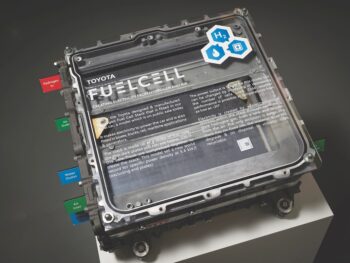 That said, it’s a technology with a great deal of promise and Toyota sees it as another potential tool to reduce our carbon emissions. Currently, the company is developing and building fuel cell systems in different sizes for marine transport, railway locomotives, trucks and static generators in addition to the Hilux project. It is clearly giving the company a breadth of knowledge and data in planning its electric future.
As part of this strategy, Toyota has been running five fuel cell-powered trucks in its own parts operation based near Brussels for over a year. We have had an opportunity to visit the operation and travel in one of the trucks to see the technology for ourselves.
The trucks are operating on four particular routes, which enables Toyota to gather data and assess how they need to progress the technology. Toyota supplies the fuel cell systems for these trucks, which are based on the DAF CF, with conversion work carried out by VDL Groep. The vehicles can travel up to 250 miles on a tank full of hydrogen. In these vehicles, the hydrogen is carried in a bank of six tanks mounted on the back wall of the truck cab.
As you would expect from any electrically propelled vehicle, noise is greatly reduced, compared with a diesel truck but there is a fair amount of noise from the gas system, which constantly supplies the fuel cell stack which generates the electricity. That noise is probably more noticeable to those in the cab than those outside around the vehicle. Obviously, the project is still in its early stages and issues such as this are among those that the development team will be addressing.
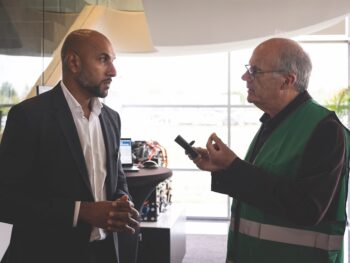
“We know that we need to make some improvements and one of them is power, which is not enough, and the range is also not enough because of the packaging space,” says Eugene Reginald, technical manager – advance powertrain design (and technical leader for the project). “The standard specification, like the sleeper cab, is not included which would then allow the driver to drive more hours.
“From the infrastructure point of view, the hydrogen stations along the route are not there,” continues Reginald. “That’s why Toyota is focusing on eco-cluster building, which means we choose an area where we build an eco-cluster with hydrogen stations, where we have selected vehicles running there. It means the stations will get the uptake that they need and there will be no issues when it comes to refuelling for the truck operators or any other vehicle.”
Can these issues be overcome to be viable enough in the face of rapidly developing battery electric technology? Time will tell.