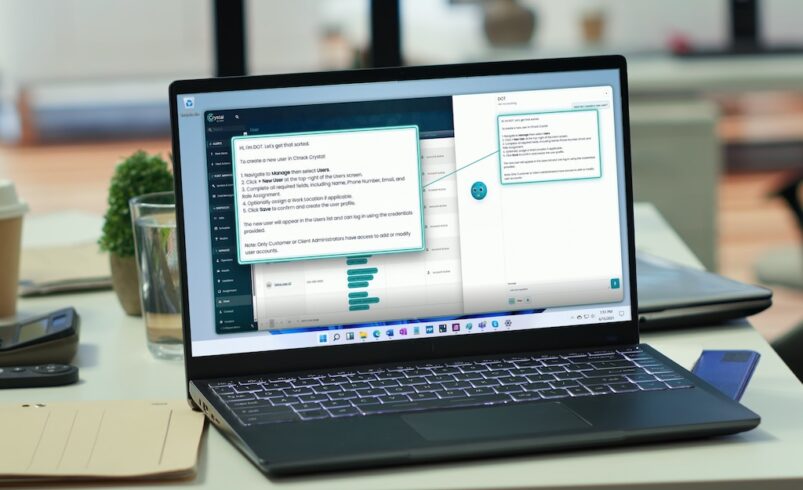
Ctrack has integrated an AI-powered assistant into its Crystal platform to transform how fleets use telematics data.
 Christened ‘Dot’, the new assistant is the first step in the company’s vision for intelligent fleet management. Dot initially provides conversational AI to help navigate everyday workflows, with results-based analysis and data-driven insights planned over the coming months.
Steve Thomas, UK managing director of Ctrack, explained: “One of the biggest criticisms of telematics over the years is around the amount of data being generated, with fleets not having resources to convert this information into decisions. With the launch of Dot, our aim is to make it much quicker and easier to interpret large volumes of data to get the specific insights that individual companies need to improve their fleet operations.”
By making AI assistance available within Crystal, Ctrack will simplify everyday tasks, reduce the time spent searching for information and deliver a more intuitive customer experience. It has been developed specifically for the platform, so Dot understands system knowledge, terminology and workflow information to provide contextually relevant guidance. Unlike a general-purpose AI chatbot, it understands questions relating to precise functionality to help customers navigate Crystal more effectively.
Thomas said the initial release will allow both new and experienced users of Crystal to access guidance without unnecessarily interrupting their work.
“Customers should be able to start with what they want to do, rather than first having to know where to look. Dot brings practical guidance directly into the platform, making it easier for customers to access the functionality available to them and gain more value.”
The next phase of development involves enhancing Dot toward advanced analytics, including operational performance analysis, risk identification, anomaly detection and predictive intelligence.
The longer-term objective for Ctrack is to make fleet intelligence increasingly accessible through a conversational experience, allowing customers to move from understanding how to use the platform towards gaining deeper insight into their operations.
According to Thomas, having access to a fixed suite of reports will become a thing of the past, with no need to export data to enable further, time-consuming analysis.
“In the future, Dot will be doing all the hard work of interrogating the data. There will be fewer constraints to what can be analysed, with reporting limited only by our ability to shape a request and the data points the telematics system captures or imports. Reporting will become much more results-based, providing the exact insight required in an easy-to-use format.”