Inside Renault’s renaissance: Head of fleet Justin Costello on group evolution
28 April 2026
0
Simon Harris
Justin Costello, head of fleet at Renault Group, explains how a corporate strategy is rewriting the fleet rulebook. By Simon Harris. In the fleet market, a 68% increase
Justin Costello, head of fleet at Renault Group, explains how a corporate strategy is rewriting the fleet rulebook. By Simon Harris.
Justin Costello, head of fleet at Renault Group
In the fleet market, a 68% increase in true fleet volume is a result that demands attention. For Renault Group UK, this rise from a 0.7% market share in 2023 to a peak of 3.6% is the result of a two-year journey. I sat down with Justin Costello, head of fleet at Renault Group UK, to discuss the structural changes behind this conquest.
Costello attributes the momentum to three main changes, starting with a massive product offensive. “Renault Group and Renault have got the newest line-up probably in the industry outside of the new entrants,” he explains. “We’ve renewed almost every model in the last two years. In the staples, we’ve added new models and new segments – particularly electric vehicles. We’ve added Scenic, and Renault 4 and Renault 5 in that B-segment have been a great growth for us.”
Renault Group and Renault have renewed almost every model in the last two years
The shift in the UK landscape is visible in the powertrain mix. “You’ll remember Renault from yesterday, right? It was diesels and Megane Tourer. Now we are around 70-80% EV, and that’s been phenomenal.”
Beyond the metal, Costello has grown his team. “We’ve added some really crucial roles: a dedicated public sector manager, a dedicated national fleet aftersales manager – to give the right in-life service – and a new national leasing manager putting together leasing and a direct proposition.” At the centre is the fleet operations team. “The fleet operations is the heart of our team. It’s sales enablement for the fleet team, but it’s also the right service for our local fleet business and that SME space.”
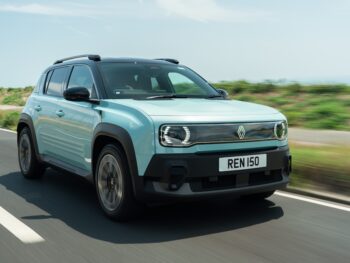
The Renault 4 has delivered strong growth due to its blend of retro charm and modern practicality
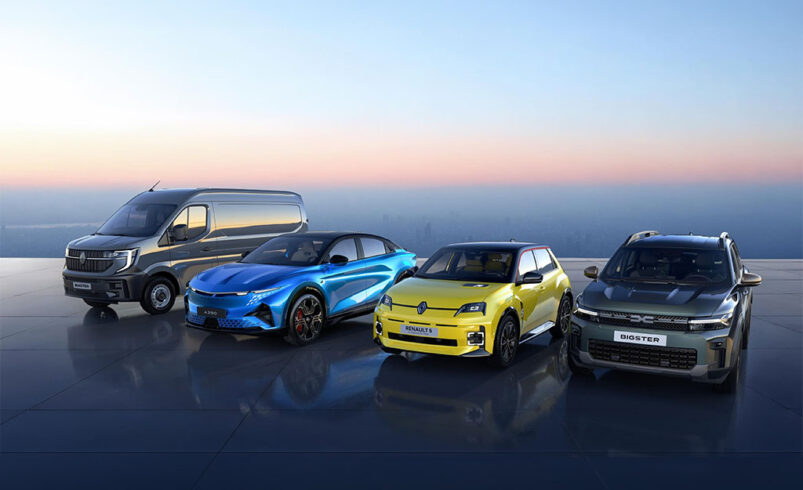
The most process-driven change is the move to a unified Renault Group identity. “Everything we do to go to market is Renault Group,” Costello says. “If you think of what we could do portfolio-wise, we can offer everything from a Dacia Spring all the way up to a Renault Master E-Tech, Alpine A290s and now 390s. One contact, one contract. It’s really important for our customers that we can offer everything in one go.”
This group approach is delivering across all badges. “We doubled Dacia volume year-on-year. Alpine? We were the strongest market outside of France. It’s been true group growth, not just Renault cars.”
With increased volume comes the need for capacity. Renault is currently growing its Pro Plus LCV specialist network from 30 to 50 sites. “We’re investing in much more capacity. We have some sites that are non-branded behind the scenes that allow us to increase our footprint,” Costello notes.
The focus is on uptime and speed of communication. “Minimising downtime is the key focus, but data is absolutely at the heart of it. We are putting all of our LCV guys through more fleet-focused service training. We’re also spending a lot of money on what we can do for uptime, empowering our customers with data.”
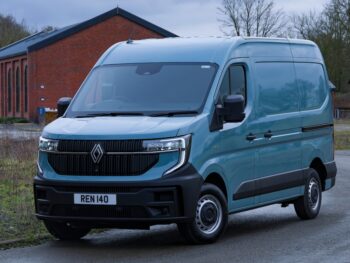
The new Master E-Tech is already proving its worth with major fleets such as Virgin Media
The new Master E-Tech is already proving its worth with ‘megafleets’ such as Virgin Media and major utility businesses. “What I really like is the fact that in the SME space, customers are also saying, ‘Oh, 280-mile range. Great. I can make that work.’ We’re really hoping our Trafic van, with new technology and that range, is going to broaden that experience even more.”
Costello’s philosophy on EVs is about “democratising” ownership. “It’s about having the right vehicle at the right price point with the right tech,” he says. Regarding the Renault 4 and 5, he notes: “The conversation’s not about range. They’ve got great range, 250 miles plus, but that doesn’t even come into it. If you’ve got the right car for the right use, with a bit of character… customers begin to think about that in a more realistic way.”
He argues that for many, a massive range isn’t the priority. “If they’re doing a 30-mile commute, do they really need 400 or 500 miles’ range? Or would they rather save £10-15k on the list price? Renault has done a really good job in having great value, whether you look at the Spring, the 5, the 4 – we are among the best-value EVs in the UK.”
This desirability feeds back into the other component of new car sales – retail. “You’re thinking, why is a head of fleet talking about retail? Used car is a retail environment. What we really need to do is make sure that we are creating a great first use on fleet and a really good second use for retail. Because of the RV situation and the competitive list price, they’re being really well received in the retail space.”
Renault has opted to use the Google OS as the heart of its media system rather than building from scratch. “It’s something people are used to; it’s very quick and dynamic, not very laggy,” says Costello. “Google Maps is one of the most popular apps for any phone; the fact that it’s integrated in our car and essentially is our sat-nav just makes customers immediately at home.”
The brand is also winning fans with a ‘one-button’ approach to safety tech. “We have one button in most of the models that you can press that sets [ADAS] up for you in one go. What a lot of customers get frustrated about is as soon as they turn their car off, they have to individually set up all those systems. Feedback on that is phenomenal.”
Costello is a proponent of physical controls. “Our designers have worked hard to balance software and physical buttons. When you’re driving, you don’t want complicated. You want safe, quick and easy. Physical buttons – are they old school? They’re really well received.”
Finally, Dacia has found its feet in the fleet world by solving specific logistical issues. “Dacia fixes fleet problems,” Costello claims. “We still have a seven-seat vehicle in the Jogger. It’s really popular because true seven-seat vehicles are in decline. We’ve also got Duster in a 4×4 for public sector and utility companies, and Duster Commercial where fleets don’t want the car tax burden.”
The introduction of the Spring has been “transformational”, offering an EV at less than £15,000 on the road. “When you’ve actually introduced the fact that we have the whole range, you then do get additional sales. Our overall growth is how powerful all of the brands are together.”
As the Alpine A390 joins the line-up – an “espresso thing” with “character” to rival the “standard-issue grey, boring SUV”, Costello says – the group portfolio is complete. For Costello, the strategy is simple: “One contact, one contract is the engine of the Renault renaissance.”