Mastering the road ahead: Expert insights from this year’s GBFE Masterclasses
15 July 2026
0
Simon Harris
The 2026 Great British Fleet Event delivered a vast range of insights from expert speakers in its masterclass sessions. We highlight some of the best points from this
The 2026 Great British Fleet Event delivered a vast range of insights from expert speakers in its masterclass sessions. We highlight some of the best points from this year’s sessions, but make sure you register next year to gain access to this invaluable intelligence and expertise. By Simon Harris and John Kendall.
The electrification masterclass at the Great British Fleet Event opened with a characteristically direct assessment from Lorna McAteer, head of fleet at National Grid, which operates 10,000 vehicles in the UK and a further 10,000 in the US.
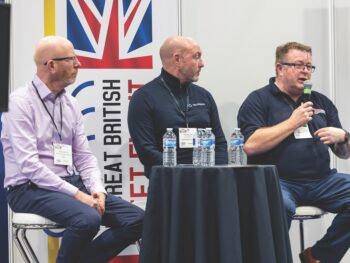
L-R: AFP board members Martin Edgecox, Lorna McAteer and James Pestell with Matthew Waller from The Charge Scheme second from right
McAtear urged fleet managers to resist panic and return to first principles. “The right vehicle, the right fuel type, the right time,” she said, adding that EVs are not the answer for every operation today – a candid admission given her employer’s own green credentials. With a fleet of more than 1,500 4x4s and a rapidly growing driver base adding 50 to 60 people a month, she spoke from hard-won experience about the importance of consistency, fairness and long-term infrastructure planning.
Her message to fleet managers was equally clear on the strategic dimension: the role has never been more important, and those running fleets must now engage boards with data, myth-bust media noise and think like energy planners — not just vehicle administrators.
Matthew Waller, general manager of The Charge Scheme, followed with a detailed examination of EV business mileage reimbursement, which he described as one of the most pressing and underestimated challenges facing fleet managers today. With nearly two million electric cars now on UK roads, the existing Advisory Electric Rate (AER) of 7p per mile for home charging and 15p for public charging leaves many drivers significantly out of pocket, he argued, potentially discouraging business travel altogether.
Waller introduced Reimburse, the Charge Scheme’s new reimbursement product, designed to calculate the true cost of charging for each driver using real public charging data, with a monthly submission process taking no more than 30 seconds. Free to employers already using the Charge Scheme, it provides a full audit trail for HMRC compliance and removes the administrative burden that has made accurate reimbursement impractical at scale.
McAtear then joined AFP board members Martin Edgecox and James Pestell for a panel discussion and Q&A – one of several sessions at the event where the conversation in the room proved as valuable as the content on stage.
Unsurprisingly, electrification featured heavily at the LCV Masterclass. Addressing the issue of which fuel was best for fleets, Gareth Jones of Speedy Hire said that whatever fuel delivers the best efficiency was the right choice. He also advised that rapid acceleration in an electric vehicle could reduce daily range by 10% to 20%, noting that using fleet management software to limit heavy-footed driving would pay dividends. Other challenges for electrification were limited infrastructure for vans and limitations from landlords on rented properties.
L-R: Mark Horton, enforcement policy manager at the DVSA, with Giles Bolton from Grosvenor and Gareth Jones of Speedy Hire
Speedy Hire’s experience with Ford E-Transits in London was that drivers like the vehicles and are finding ways to extend daily range. The company is experiencing 12V battery drain due to continuous power demands from vehicle ancillaries such as beacons and tail-lifts. Speedy Hire’s solution has been to fit solar panels, which trickle-charge the battery through the day.
Mark Horton, enforcement policy manager at the DVSA, raised the issue of compliance with LCVs. He said that around 3,000 people are killed each year by LCVs, much higher than the more regulated HGVs.
He noted that overloading is the biggest issue in roadside checks with 54% of vehicles stopped being overloaded. Insecure loads are another issue and the DVSA ran Operation Mamba which finished in March this year, targeting the car transport and construction sectors because of their poor compliance. As he pointed out, a 3,500kg GVW car transporter cannot carry many modern cars and remain compliant. The operation will be repeated.
The risk management and driver wellbeing masterclass brought together three perspectives on keeping fleets safe and compliant.
Professor David Crundall, CTO and co-founder of Esitu Solutions, made the case for hazard perception training, presenting research showing it reduces speeding, harsh braking and collision risk, while also cutting fuel and maintenance costs. He challenged the assumption that such training is only useful for learner drivers, arguing that vehicle-specific and job-specific hazard clips, delivered via VR, microlearning or classroom sessions, can sharpen the skills of experienced professional drivers too.
Charlotte Le Maire, founder and partner at LMP Legal, addressed operational resilience with a stark warning: poor evidence of driver health checks, drug and alcohol policies, and incident response procedures can expose companies and senior managers to prosecution. She urged delegates to treat the “golden minutes” after a collision with the same seriousness as the incident itself, ensuring drivers know to give only their name and vehicle details at the roadside.
Representing Jaama, Michelle Batty, head of marketing, presented findings from a new fleet compliance benchmarking report, revealing that while driver risk investment is rising, only 17% of fleets have fully integrated their compliance data, leaving most reacting to incidents rather than predicting them.
The Technology, Data and AI masterclass examined how artificial intelligence is reshaping fleet safety, maintenance and security.
L-R: Ken Munro of Pen Test Partners, Gonzalo Escobar at Motive and Ryan Naughton from the AA
Gonzalo Escobar, senior solutions engineer at Motive, outlined the company’s focus on driver safety, tracking and workforce management, highlighting new camera hardware developed with Falcom and Motive AI Coach, which delivers automated, bespoke coaching conversations to drivers via avatar based on detected unsafe behaviours such as tailgating.
Ken Munro of Pen Test Partners delivered a sobering survey of automotive cybersecurity failures, demonstrating how vulnerabilities in telematics platforms, aftermarket car alarms and EV chargers have allowed researchers to compromise vehicle networks, steal cars and even take control of corporate systems through a single compromised telematics control unit.
Ryan Naughton, head of connected car at the AA, detailed how predictive AI models built on data from 3.5 million annual breakdowns have improved battery failure prediction to 80% accuracy and reduced the AA’s own fleet downtime by 40%, with vehicle availability now running at 97% compared with an industry average of around 85%.
A common thread across all three presentations was the importance of accuracy and trust: unreliable alerts or insecure systems erode the value of any technology investment, regardless of how sophisticated the underlying AI.
The EVs and Sustainability: From Ambition to Execution Masterclass offered practical guidance for fleets at every stage of electrification.
Melanie Creedy of Northgate Businesses Group
Melanie Creedy of Northgate Businesses Group outlined the Drive to Zero programme, which has analysed over 3,000 customer vehicles and identified more than half as EV ready, representing potential savings of nearly 10,000 tonnes of CO2. She emphasised that successful transitions depend on driver engagement and tailored implementation rather than blanket electrification.
Dan Lawrence-Eyre, co-founder of Diode, illustrated how data analysis serves different fleet priorities through a series of customer profiles, from cost-focused operators seeking financial justification to sustainability managers under pressure to demonstrate measurable carbon savings to their supply chain.
Csaba Vince, representing Volteum, argued that electrification’s real complexity lies in daily operations rather than initial vehicle selection, citing customers including Royal Mail and Dundee City Council, which have achieved savings exceeding £600,000 through avoided infrastructure investment and operational efficiency.
Matthew Waller of the Charge Scheme detailed how salary sacrifice and dedicated charging reimbursement products can save employees up to 50% on EV costs, addressing the affordability barriers that remain the biggest obstacle to adoption, particularly for drivers without home charging access.