The EV tide has turned: Now infrastructure must keep pace
- 9 September 2026
- 0
Nick Tatum, chief EV and energy officer at Moto Hospitality, marks World EV Day 2026 with a look at why the debate around EV adoption is effectively over,

Nick Tatum, chief EV and energy officer at Moto Hospitality, marks World EV Day 2026 with a look at why the debate around EV adoption is effectively over,

Nick Tatum, chief EV and energy officer at Moto Hospitality, marks World EV Day 2026 with a look at why the debate around EV adoption is effectively over, and why the real challenge now is ensuring charging infrastructure keeps pace with rapidly growing demand.

The question is no longer whether Britain is going electric. It’s happening, and faster than many predicted. According to the Society of Motor Manufacturers and Traders (SMMT), new car registrations grew 13.7% year-on-year to 94,236 units in August 2026, with battery electric vehicles reaching a 29.8% market share – the second-highest monthly figure so far this year. August always sees a seasonal uplift in battery electric car (BEV) share, but that uplift is itself growing year-on-year, from around 20% in 2023 to almost 30% in 2026. The long-term direction of travel remains clear.
Year-to-date, BEV share stands at 25.6% – still short of the 33% Zero Emission Vehicle mandate target. Some in the industry point to this gap as evidence the mandate itself needs recalibrating. We’d argue the opposite: demand is following a strong upward trajectory, and the real gap holding adoption back is not consumer appetite, it’s whether charging infrastructure can scale fast enough to meet it.
Today, as we mark World EV Day, the conversation must shift. The urgent question is no longer if Britain will electrify transport, but whether infrastructure can scale fast enough to meet accelerating demand – and reach every driver equally.
The numbers speak for themselves. More than 2.18 million electric vehicles now travel UK roads. The Society of Motor Manufacturers and Traders’ (SMMT) chief executive Mike Hawes recently noted that “motorists are responding to the huge choice and compelling offers available”, evidence that consumer confidence in EVs has arrived.
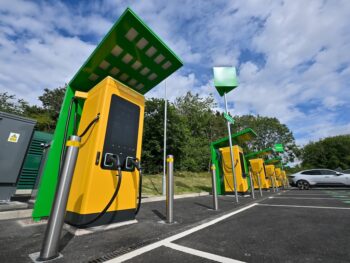
The Government is broadly on track to meet its target of 300,000 public charge points by 2030. But a Public Accounts Committee report found that availability remains patchy across large swathes of the UK motorway network specifically, and that 43% of charge points remain concentrated in London and the South-East, leaving rural areas and vital travel corridors at risk of falling behind without further intervention. This is precisely where motorway service operators such as Moto must lead.
Encouragingly, the Prime Minister has already signalled he understands the stakes. He has identified slow, costly grid connections and regional infrastructure gaps as barriers to growth, central to his reindustrialisation agenda. This is the right diagnosis, but it must extend explicitly to EV charging. The same grid delays holding back manufacturing and regional growth are holding back the charging capacity our motorways need.
This is a moment of opportunity. Infrastructure providers who move decisively now will define the next decade of UK transport. Those who wait will find themselves playing catch-up to demand that has already arrived.
For freight operators and HGV drivers, the backbone of our supply chains, the opportunity is equally significant. Electric heavy goods vehicles represent the next frontier of sustainable logistics, and strategic investment in ultra-rapid charging infrastructure along motorway networks will unlock this transition at scale.
Moto is scaling ahead of demand, not catching up to it. We’re investing £500m to enhance facilities across our estate, including plans to quadruple EV charging capacity at our sites and establish 15 eHGV superhubs with up to 100 charging bays each.
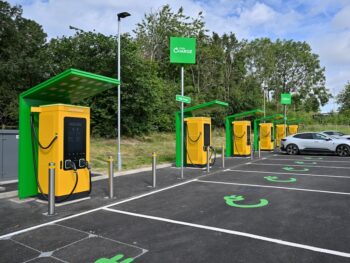
This kind of investment requires confidence, and confidence requires policy certainty. Rather than recalibrating ambition downward, government should focus on removing the delivery bottlenecks preventing the ZEV mandate trajectory from being met. This means:
We’re proving that ambition and delivery go hand in hand. Our recent 75+ year lease extensions with the Department for Transport and National Highways unlock a clear, long-term pathway for investment. Across 10 strategic motorway sites, we’re deploying this £500m investment to build next-generation service areas, with world-class EV charging infrastructure, enhanced facilities for HGV drivers, renewable energy solutions and smart grid management systems.
Our 1,000+ ultra-rapid charging bays already serve millions of motorists annually across the UK motorway network, directly addressing the motorway charging gaps parliament has identified. This is the foundation for what comes next.
To government: the trend is undeniable and growing every year. Rather than easing the mandate, extend the same urgency you’ve shown on grid delays and regional growth to EV charging infrastructure specifically.
To industry: this is a competitive opportunity, not a compliance exercise. Those who invest boldly today will define the UK’s EV future.
To motorists: the transition is under way, and it’s accelerating. Infrastructure is scaling to meet you, wherever you travel.
The direction of travel on EV adoption is clear. The real work of building infrastructure that matches the UK’s ambition, everywhere, has already begun. The challenge now is keeping pace.

