NOx sensors are now top of Britain’s most common van warranty repairs, driven by increasingly sophisticated emissions systems and vehicle electronics.
 Warranty Solutions Group (WSG) analysed more than 3,000 authorised LCV warranty claims dating back to July 2021 to reveal the evolving profile of commercial vehicle repairs.
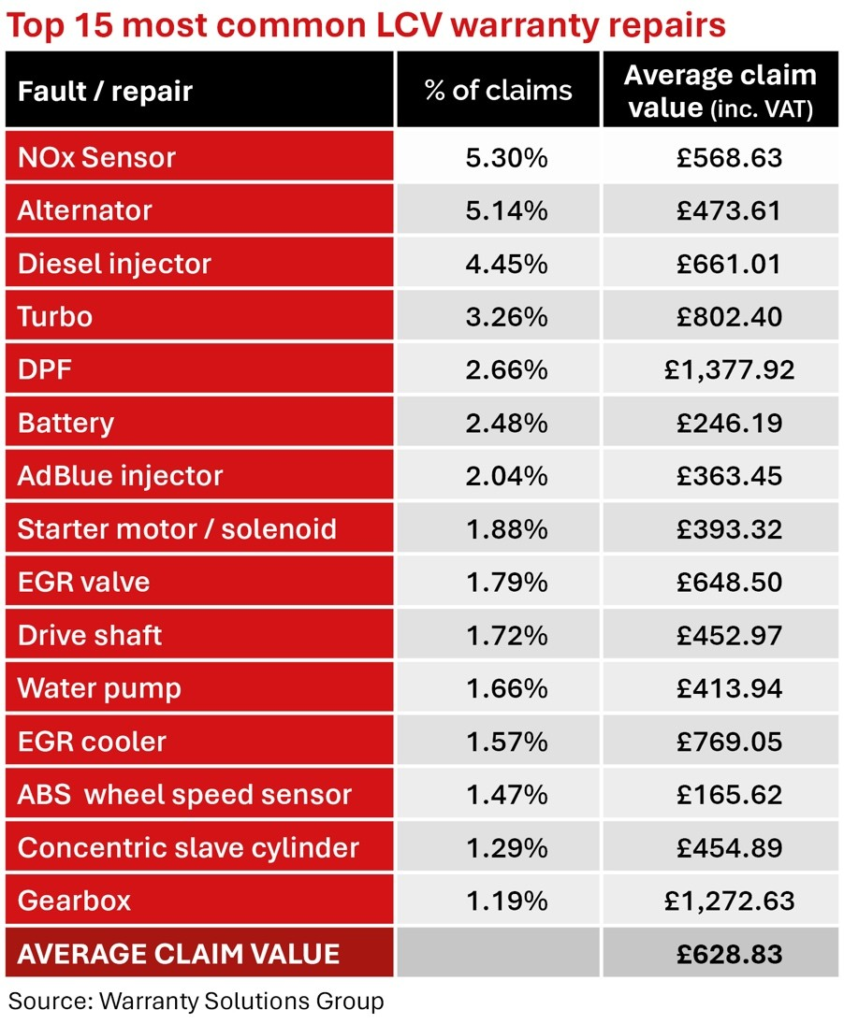
The claims intelligence shows that NOx sensors accounted for 5.3% of all authorised LCV warranty claims, making them the single most common repair across the UK van parc.
Alternators (5.1%), diesel injectors (4.5%), turbochargers (3.3%) and diesel particulate filters (2.7%) complete the five most frequent warranty repairs.
Rounding out the top 10 were batteries, AdBlue injectors, starter motors, EGR valves, driveshafts and water pumps. WSG noted that this demonstrates the wide range of mechanical, electrical and emissions-related components now affecting modern commercial vehicles.
Perhaps most significantly, four of the 10 most common warranty repairs are directly linked to emissions-control technology, illustrating how increasingly sophisticated emissions systems have become one of the defining maintenance challenges facing today’s van operators.
Dennis Brett, claims director at Warranty Solutions Group, said: “These aren’t isolated incidents; they’re recurring issues that operators need to understand and plan for. Modern vans are delivering higher levels of efficiency, lower emissions and greater connectivity than ever before, but that progress has also increased the complexity of vehicle maintenance.
“Components such as NOx sensors, diesel particulate filters, AdBlue systems and electronic control units are becoming increasingly critical to vehicle performance. That makes preventative maintenance, early diagnosis and access to specialist technical expertise more important than ever. Operators that understand these trends will be in a much stronger position to reduce downtime, manage maintenance budgets and improve whole-life vehicle performance.”
 Average van warranty repair now exceeds £628
Across the entire dataset, the average LCV warranty repair now stands at £628.83, with an average labour cost of £127.72 per claim and an average labour rate of £60.47 per hour.
Rather than being dominated by catastrophic engine failures, today’s warranty claims are increasingly centred on emissions systems, electronic components and connected vehicle technology. While many of these repairs generate lower invoices than complete engine or transmission failures, their frequency means they can have a significant cumulative impact on operating costs, workshop capacity and vehicle availability.
Dennis Brett said one of the biggest misconceptions is that the highest repair bill represents the biggest reliability issue.
“In reality, it’s often the faults that occur hundreds or even thousands of times across a vehicle parc that have the greatest commercial impact. A £300 or £500 repair repeated across a fleet can ultimately cost operators far more than the occasional major engine failure.”
For operators, the challenge is no longer simply preparing for the occasional major repair. Increasingly, it is about managing the growing number of technology-driven faults that quietly erode uptime and profitability over the lifetime of a vehicle.
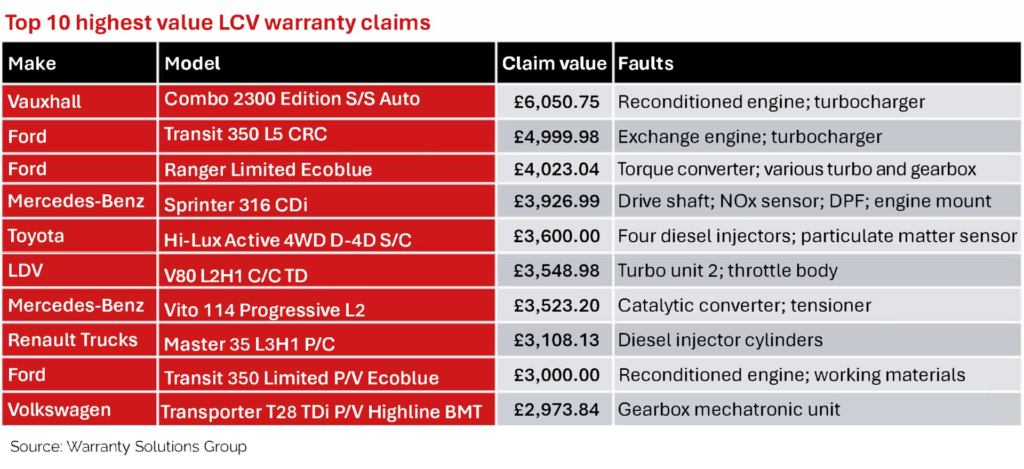
At the other end of the scale, WSG’s analysis highlights the financial impact of major component failures, with the highest individual warranty repair exceeding £6,000. Engine, gearbox and turbocharger repairs continue to generate the largest repair invoices once vehicles move beyond their manufacturer warranty.
The findings reinforce a broader shift across the commercial vehicle sector as operators retain vehicles for longer while managing increasingly complex technology. As emissions legislation, software and onboard electronics continue to evolve, understanding real-world reliability is becoming increasingly important.
Brett added: “By analysing more than 3,000 authorised warranty claims over five years, we’re able to identify patterns that simply aren’t visible from individual repairs. Claims intelligence provides a unique insight into what’s really happening once vehicles are out in the field and how reliability is evolving as technology becomes more sophisticated.”
He finished: “Every warranty claim tells a story, but thousands of warranty claims reveal meaningful trends. That’s where claims intelligence becomes incredibly valuable. It enables fleets, dealers and operators to make more informed maintenance decisions, better manage total cost of ownership and ultimately keep more vehicles on the road.”